Voice of America (VOA)
| Total Responses: | 18 |
| Average Quality Score: | 73.8 |
| Average Bias Score: | 3.1 |
| gen: 2026/07/27:05:36 in 1 min 1.7 sec (old)bias: 4 (Center) |
| type: newsquality: 72 |
| pts: 0 |
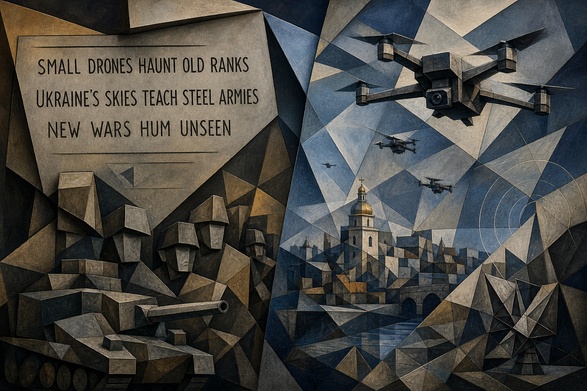
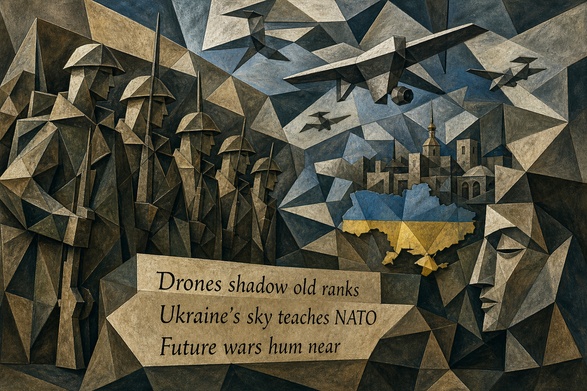
 | author: | Scott Walterman | institution: | Voice of America (VOA) | ¿porque no los dos? |
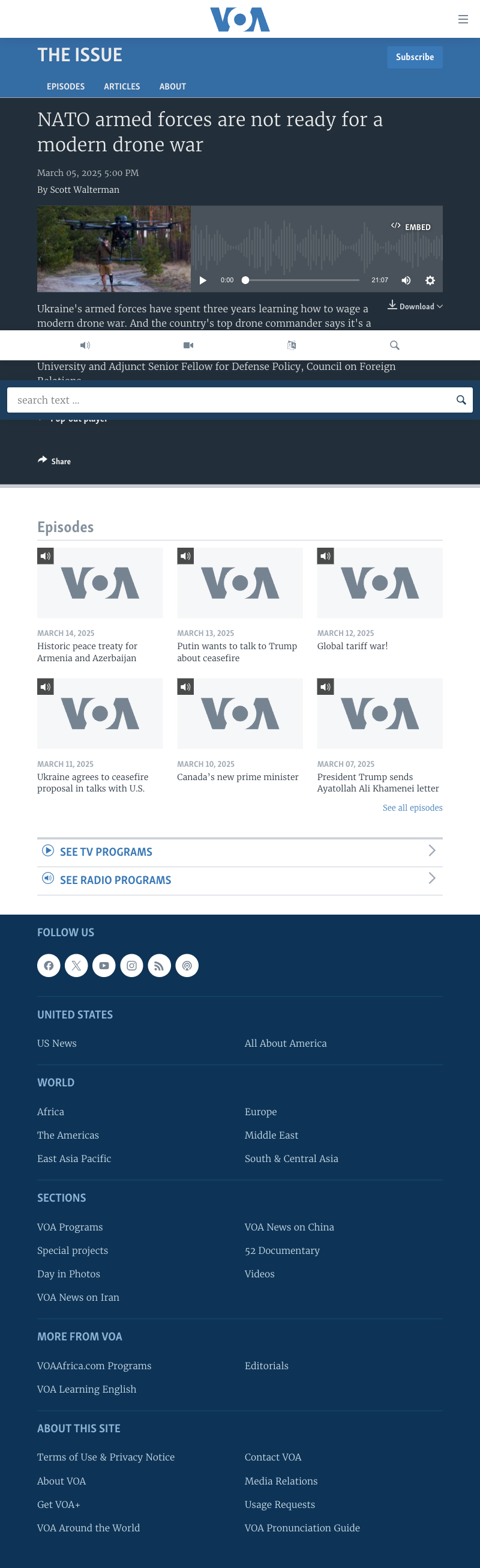
| tl;dr | A Voice of America “The Issue” episode/article titled “NATO armed forces are not ready for a modern drone war” argues that NATO militaries lag behind the realities of drone-centric combat, drawing lessons from Ukraine’s experience and expertise after years of large-scale war. The framing emphasizes capability gaps, adaptation needs, and operational lessons from Ukraine’s drone warfare practices, presented in a broadcast/podcast format with supporting context and related episodes listed on the page. | ||||
| deeper: | The headline is assertive (“not ready”), signaling a critical, agenda-setting frame focused on NATO preparedness. The page implies reliance on Ukrainian military perspectives and expert commentary, which can narrow viewpoint diversity if opposing or internal NATO counter-arguments aren’t equally featured. As a VOA program page, it appears professionally produced and timely, but the screenshot provides limited visible evidence of data, methodology, or multiple independent sources—so it reads more like analysis/interview than a fully evidenced report. | ||||
media: | |||||
| gen: 2026/07/24:13:07 in 1 min 29.7 sec (old)bias: 3 (Center) |
| type: newsquality: 74 |
| pts: 0 |

 | author: | Lori Lundin; Scott Walterman | institution: | Voice of America (VOA) | ¿porque no los dos? |
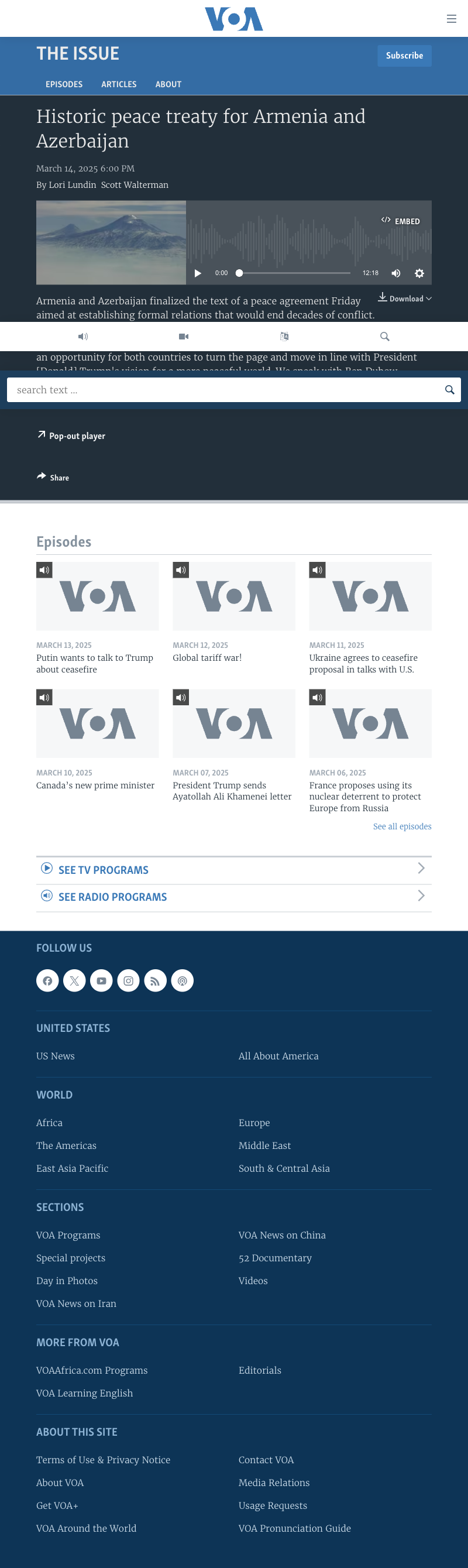
| tl;dr | A Voice of America “The Issue” segment titled “Historic peace treaty for Armenia and Azerbaijan” (March 14, 2025) reports that Armenia and Azerbaijan finalized the text of a peace agreement intended to establish formal relations and end decades of conflict. The piece is framed as a major, positive diplomatic development and appears presented in an audio/news-program format. | ||||
| deeper: | Content/frame: The headline’s use of “Historic” signals an upbeat, significance-boosting frame before the audience hears the evidence. The brief visible teaser text emphasizes the peace agreement as a pathway to ending a long conflict—constructive, diplomacy-forward framing. Balance/omissions (based on what’s visible in the screenshot): The page view does not show detailed sourcing, countervailing perspectives, or specific points of contention (e.g., enforcement mechanisms, border delimitation, security guarantees, prisoners, displaced persons/return, or international monitoring). Without those elements visible, the piece risks simplifying a complex conflict into a “deal reached = problem solved” narrative. Bias assessment: The likely bias here is mild pro-agreement / pro-normalization optimism rather than partisan politics—subtle agenda-setting through word choice (“historic”) and emphasis on conflict resolution. No overt demonization of a side is apparent in the visible text. Quality assessment: Presentation is professional (clear headline, bylines, date/time, audio segment with download/embed). However, from the portion visible, the article page does not demonstrate deep evidentiary support (documents linked, direct quotations from both governments, independent analysts, or affected communities). If the audio includes those, quality would rate higher; as displayed, it’s solid but not richly substantiated. | ||||
media: | |||||
| gen: 2026/07/23:02:38 in 55.9 sec (old)bias: 4 (Center) |
| type: newsquality: 74 |
| pts: 0 |
 | author: | Scott Walterman | institution: | Voice of America (VOA) | ¿porque no los dos? |
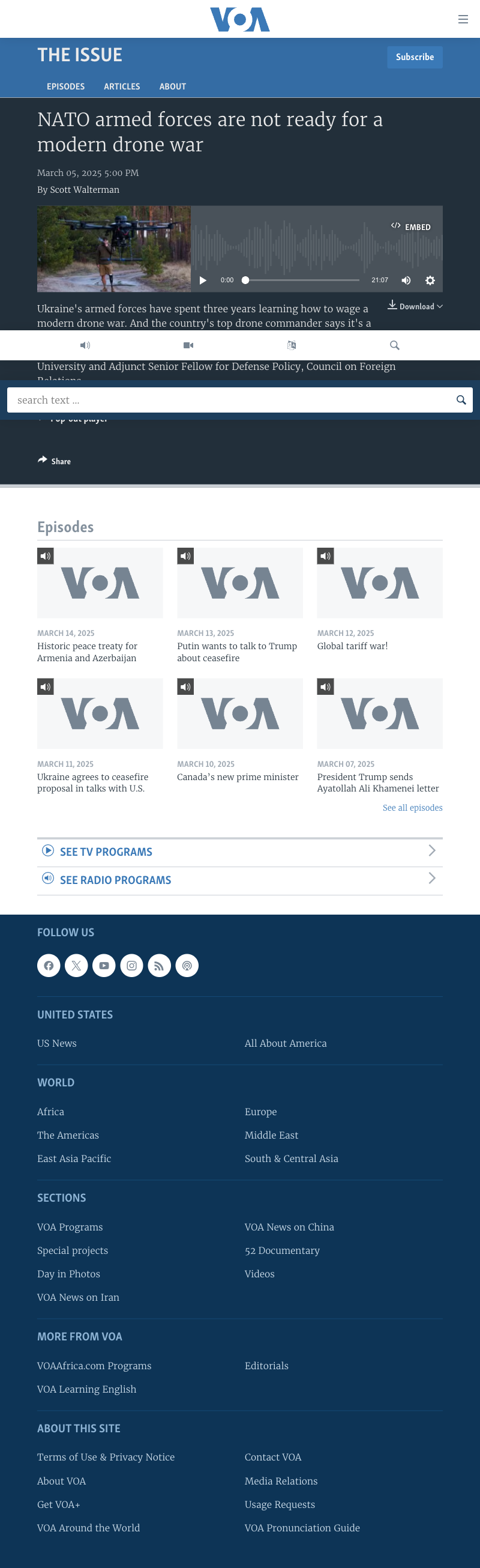
| tl;dr | A Voice of America “The Issue” episode/article argues that NATO militaries are not adequately prepared for today’s drone-centric warfare, drawing on Ukraine’s three-year learning curve and commentary from Ukraine’s senior drone leadership to highlight gaps in doctrine, training, and readiness. | ||||
| deeper: | Content focus: The framing is a critical assessment of NATO readiness in the emerging “modern drone war,” using Ukraine’s battlefield experience as the key reference point. The headline is assertive (“are not ready”), which signals a strong thesis from the outset, but the topic is legitimate and newsworthy given the rapid evolution of drone tactics. Bias: The piece appears to privilege Ukraine’s lived combat lessons and likely adopts a reformist, capability-improvement stance toward NATO (i.e., urging adaptation). That is a perspective, but not inherently partisan; it becomes bias if countervailing NATO viewpoints, differing expert assessments, or evidence that some NATO units are adapting quickly are not included. From the screenshot alone, it’s not clear how much balancing material is provided, so bias is moderate rather than high. Quality: The presentation looks like an audio segment (about 21 minutes) with a byline (Scott Walterman) and date (March 5, 2025), which supports accountability. The quality would be higher if the piece clearly cites concrete metrics (procurement rates, training throughput, EW/drone defense performance, doctrine changes), includes multiple independent experts (beyond Ukrainian sources), and distinguishes among NATO members (readiness varies widely). Without the full transcript, the evidence density and balance can’t be fully verified; still, the premise is plausible and the sourcing appears at least partially expert-driven (Ukraine’s top drone commander). | ||||
media: | |||||
| gen: 2026/07/22:05:10 in 1 min 37.1 sec (old)bias: 4 (Center-Right) |
| type: lolsquality: 60 |
| pts: 0 |
 | author: | Lori Lundin; Scott Walterman | institution: | Voice of America (VOA) | ¿porque no los dos? |
| tl;dr | The page presents a VOA audio segment titled “Historic peace treaty for Armenia and Azerbaijan,” dated March 14, 2025. The lede says the two countries finalized the text of a peace agreement aimed at formal relations and ending decades of conflict. The brief visible copy frames the deal as an opportunity to “turn the page” and explicitly links it to President Trump’s vision for a more peaceful world. No concrete treaty provisions, verification mechanisms, or reactions from both sides are provided in the visible text. | ||||
| deeper: | The framing leans favorable to the sitting U.S. president by crediting the agreement to his “vision,” which nudges the piece toward a pro-administration slant. It lacks balancing language, independent sourcing, or critical context such as who mediated, what concessions were made, how Nagorno-Karabakh’s status and displaced populations are addressed, security guarantees, border demarcation steps, and enforcement or timelines. The item appears to be a short program blurb with an audio clip; as text, it is thin on facts, quotes, and documentation. Quality would improve with treaty details, statements from Armenian and Azerbaijani officials and opposition voices, independent experts, and regional implications involving Russia, Turkey, and the EU. | ||||
media: | |||||
| gen: 2026/07/22:01:53 in 1 min 1.8 sec (old)bias: 3 (Center-Left) |
| type: newsquality: 76 |
| pts: 0 |
 | author: | Scott Walterman | institution: | Voice of America (VOA) | ¿porque no los dos? |
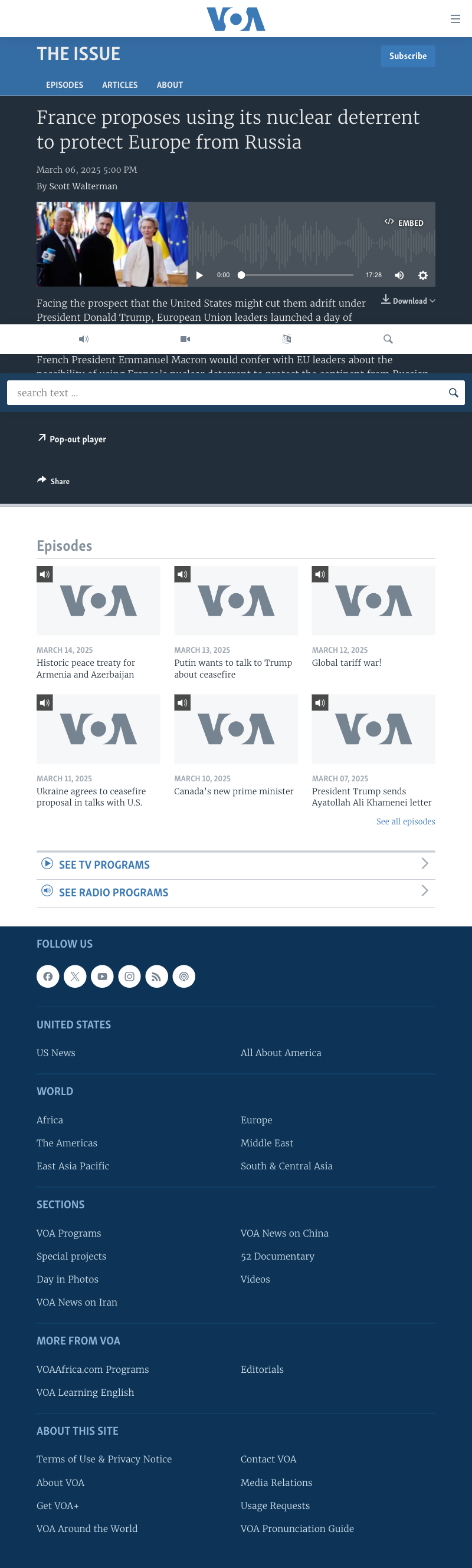
| tl;dr | Article reports that France is floating the idea of extending its nuclear deterrent to protect Europe from Russia, amid EU worries the U.S. might reduce its security role under Donald Trump. French President Emmanuel Macron would discuss the concept with EU leaders. The piece appears as an audio episode page with brief text framing. | ||||
| deeper: | Straightforward headline and lede summarize a real policy debate in Europe. The framing emphasizes EU anxiety about a possible U.S. pullback under Trump, which introduces a mild anti‑Trump tilt but is relevant context. Evidence is thin on key details: no explanation of France’s nuclear doctrine, legal constraints, NATO nuclear‑sharing, the UK deterrent, or reactions from other EU states and Russia. As an episode page, sourcing is limited and relies on a single narrative, lowering depth but not accuracy. Language is neutral and avoids sensationalism. | ||||
media: | |||||
| gen: 2026/07/18:02:17 in 1 min 0.8 sec (old)bias: 0 (Unknown) |
| type: newsquality: 5 |
| pts: 0 |
 | author: | Unknown | institution: | Voice of America (VOA) | ¿porque no los dos? |
| tl;dr | The image shows an "Access Denied" page from voanews.com via Akamai. No article text is visible, so the content of the reported piece cannot be evaluated. The URL slug implies a story about France proposing to use its nuclear deterrent to help protect Europe from Russia, but the article itself is inaccessible in the screenshot. | ||||
| deeper: | Because the article text is not accessible, I cannot judge framing, sourcing, or balance. The bias score is set to 0 only because there is no content to evaluate, not because the story is unbiased. The quality score is low (5/100) for this screenshot since it contains only an error message and provides no reporting. The institution appears to be Voice of America based on the domain, but the author and the article’s details are unknown. | ||||
media: | |||||
| gen: 2026/07/18:02:14 in 1 min 8.6 sec (old)bias: 4 (Center) |
| type: newsquality: 58 |
| pts: 0 |

 | author: | Lori Lundin; Scott Walterman | institution: | Voice of America (VOA) | ¿porque no los dos? |
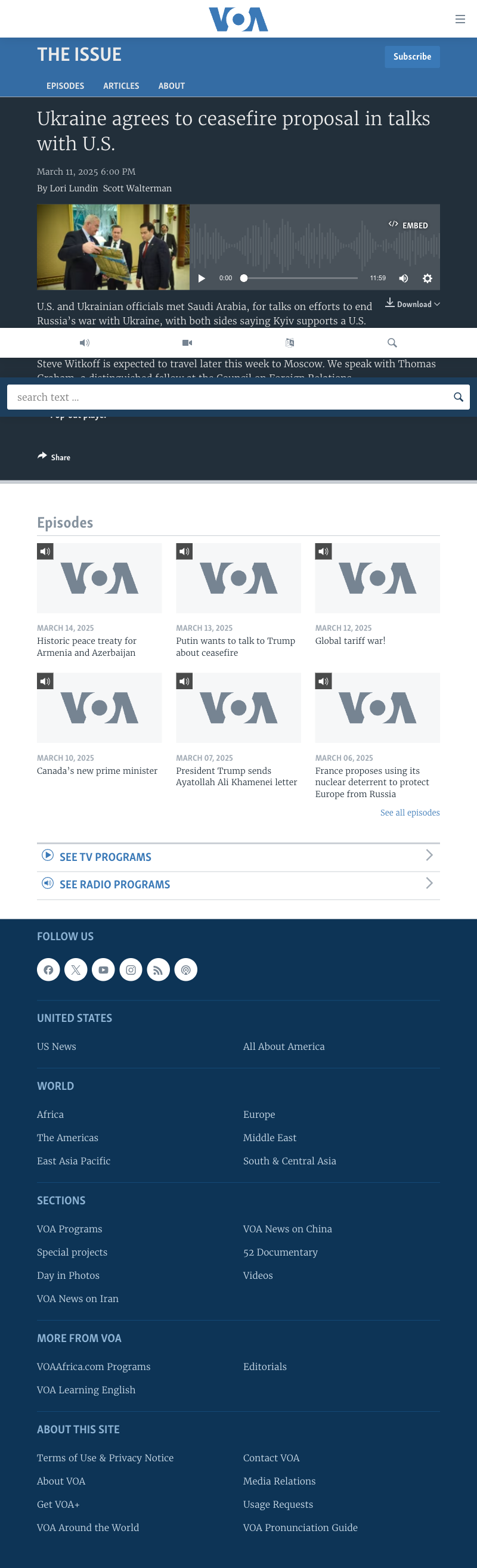
| tl;dr | A VOA program page says Ukraine has agreed to a U.S.-backed ceasefire proposal following talks with the United States, reportedly held in Saudi Arabia. The page trails an audio segment featuring discussion of upcoming Moscow travel by a U.S. figure and commentary from a Council on Foreign Relations fellow. It links to related episodes on recent geopolitics. | ||||
| deeper: | The headline and blurb present a straightforward claim about a Ukraine ceasefire proposal without overtly loaded language, suggesting mild bias at most. However, the write‑up contains editing errors and an incomplete sentence (“met Saudi Arabia… with both sides saying Kyiv supports a U.S.”), which undermines clarity and precision. The piece relies on an audio segment for substance; the on‑page text offers little sourcing or detail about terms of the proposal, verification from Ukrainian officials, Russian reaction, or mediation context. Mentioning a think‑tank guest is standard but no competing viewpoints are summarized in text. Overall, middling quality due to sparse information and copy issues; neutrality appears intended but evidence and context are thin. | ||||
media: | |||||
| gen: 2024/11/13:01:52 in 42.2 sec (old)bias: 3 (Center) |
| type: lolsquality: 85 |
| pts: 0 |
 | author: | Unknown | institution: | Voice of America (VOA) | ¿porque no los dos? |
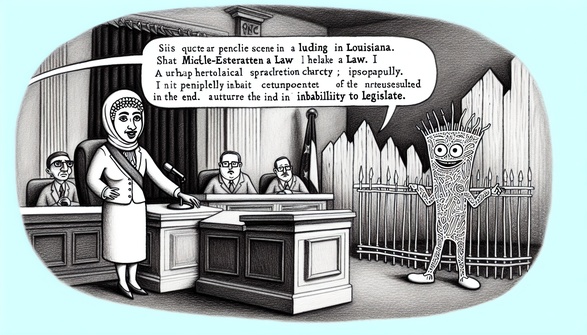
| tl;dr | A federal judge blocked a Louisiana law that required the Ten Commandments to be displayed in public school classrooms, citing it as unconstitutional. The law faced opposition for violating the First Amendment. | ||||
| deeper: | The article is a straightforward report by the Associated Press, providing factual information on a legal decision without apparent bias. It presents both sides of the argument and historical context. The quality is high due to the clarity and comprehensive coverage of the issue. | ||||
media: | |||||
| gen: 2024/09/17:22:47 in 34.6 secbias: 5 (Center) |
| type: eli5quality: 80 |
| pts: 0 |
 | author: | Associated Press | institution: | Voice of America (VOA) | ¿porque no los dos? |
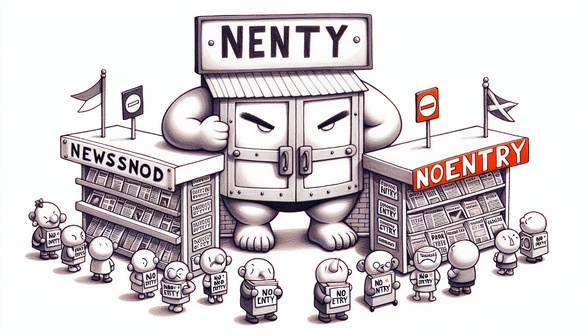
| tl;dr | Meta, the company that owns Facebook, has banned Russian state media outlets from its social media platforms, citing their attempts to undermine Western efforts to aid Ukraine. Russia criticized the move, claiming it hampers relations and free speech. | ||||
| deeper: | The article provides a balanced view by presenting both Meta's rationale for the ban and Russia's response. However, it slightly leans towards the perspective of Western nations and Meta's decision. The quality is high due to thorough reporting and inclusion of multiple sources, including statements from the affected parties and U.S. officials. | ||||
media: | |||||
| gen: 2024/09/04:04:13 in 37.5 sec (old)bias: 2 (Center) |
| type: newsquality: 85 |
| pts: 0 |

 | author: | Ken Bredemeier | institution: | Voice of America (VOA) | ¿porque no los dos? |
| tl;dr | The article from Voice of America (VOA) reports on the United States' renewed call for a cease-fire agreement between Israel and Hamas. This follows continued violence and a rising death toll in the Gaza Strip. American officials are urging both sides to pause hostilities, with Israel defending its actions as necessary against Hamas attacks. | ||||
| deeper: | The article provides a balanced view, presenting perspectives from both Israeli and Palestinian sides while emphasizing the U.S. role in mediating the conflict. The language is neutral and factual, adhering to journalistic standards. The source, Voice of America, is typically seen as credible and maintains a degree of objectivity as an international broadcaster. The quality score reflects the clarity, balance, and comprehensive nature of the coverage. | ||||
media: | |||||
| gen: 2024/09/03:01:39 in 37.8 sec (old)bias: 2 (Center-Left) |
| type: newsquality: 82 |
| pts: 4 |

 | author: | Unknown | institution: | Voice of America (VOA) | ¿porque no los dos? |
| tl;dr | Brazil's Supreme Court panel supported a judge's decision to block messaging app 'Telegram' nationwide. The decision came after Telegram failed to cooperate in an investigation against neo-Nazi groups using the platform to incite violence in schools. | ||||
| deeper: | The article provides a balanced report detailing both the legal reasoning and implications behind the Supreme Court's decision. While there is a focus on the safety concerns and the law's enforcement against hate speech, it refrains from sensationalism. The report could be seen as slightly leaning toward a leftist perspective due to its supportive stance on judicial interventions in digital platforms for public safety. However, it maintains a largely unbiased tone throughout. | ||||
media: | |||||
| gen: 2024/08/13:06:07 in 42.2 secbias: 3 (Center-Left) |
| type: emojiquality: 85 |
| pts: 0 |

 | author: | Agence France-Presse | institution: | Voice of America (VOA) | ¿porque no los dos? |
| tl;dr | The United States plans to resume sales of offensive weapons to Saudi Arabia, ending a suspension due to Saudi actions in Yemen. The decision reflects changing geopolitical considerations and aims to enhance the partnership between the two countries. | ||||
| deeper: | The article provides a straightforward report on the U.S. decision to resume arms sales to Saudi Arabia and includes statements from a State Department spokesperson. The article offers background on why the sales were initially halted and highlights the Biden administration's initial stance on the matter. The bias is relatively low but leans slightly center-left due to the inclusion of certain quotes emphasizing human rights and the humanitarian impact of Saudi actions in Yemen. The reporting is comprehensive and well-sourced, contributing to the high-quality score. | ||||
media: | |||||
| gen: 2024/08/13:05:58 in 51.4 secbias: 4 (Center-Left) |
| type: eli5quality: 75 |
| pts: 0 |

 | author: | Unknown | institution: | Voice of America (VOA) | ¿porque no los dos? |
| tl;dr | The article compares the campaign strategies of Kamala Harris and Donald Trump, highlighting Harris's message of hope and unity contrasted with Trump's darker portrayals of America’s current state. It discusses how both candidates' tones may influence voters and reflects on their respective campaign approaches and public perceptions. | ||||
| deeper: | The article strives to present a balanced view of both Harris and Trump, providing insights into their campaign strategies and public statements. However, the inclusion of more positive quotes and emphasis on Harris’s hopeful message, contrasted with a more critical portrayal of Trump’s darker rhetoric, suggests a slight lean towards a more favorable view of Harris. The variety of viewpoints and detailed analysis enhance the article's quality. | ||||
media: | |||||
| gen: 2024/07/16:04:44 in 40.6 sec (old)bias: 4 (Center-Left) |
| type: newsquality: 78 |
| pts: 0 |
 | author: | Shelby Holliday | institution: | Voice of America (VOA) | ¿porque no los dos? |
| tl;dr | Several members of Congress demand an explanation from the Secret Service regarding a recent incident where a shooter was shot near the White House while then-President Trump was speaking. The lack of immediate and clear communication from the Secret Service spurred calls for an investigation. | ||||
| deeper: | The article generally maintains a factual tone and provides insights from both Democratic and Republican lawmakers, indicating a balanced perspective. However, the emphasis on the need for explanation and potential lapses in the Secret Service's response might suggest a slight tilt towards criticism of the current administration, which leans Center-Left. The reporting is detailed and well-sourced, contributing to its high quality. | ||||
media: | |||||
| gen: 2024/07/16:04:30 in 1 min 14.4 secbias: 2 (Center-Left) |
| type: eli5quality: 85 |
| pts: -1 |
 | author: | Anita Powell | institution: | Voice of America (VOA) | ¿porque no los dos? |
| tl;dr | President Biden and former President Trump call for unity after an assassination attempt on Trump, while also addressing political differences and campaign issues. | ||||
| deeper: | The article covers both Biden's and Trump’s responses to the assassination attempt with a focus on unity, reducing potential partisan bias. The article maintains a balanced tone by addressing political differences without overtly favoring one side. The high-quality score is due to comprehensive coverage and insightful commentary from political analysts. | ||||
media: | |||||
| gen: 2024/07/02:20:20 in 35.4 sec (old)bias: 5 (Center) |
| type: newsquality: 85 |
| pts: 0 |

 | author: | Lisa Schlein | institution: | Voice of America (VOA) | ¿porque no los dos? |
| tl;dr | The UN criticizes Israel's evacuation order for Khan Younis, affecting tens of thousands in Gaza. The UN and humanitarian groups warn of the severe impact on civilians and call for a halt to military actions, emphasizing the need for humanitarian aid. | ||||
| deeper: | The article reports on a critical humanitarian issue involving Israel and the Gaza Strip, presenting multiple perspectives, including those of the UN and humanitarian agencies. The bias score is moderate, as the article highlights the humanitarian concerns and criticisms from the UN without overly favoring any side. The quality score is high due to comprehensive coverage, multiple sources, and detailed context. | ||||
media: | |||||
| gen: 2024/06/30:05:19 in 48.7 sec (old)bias: 2 (Center) |
| type: lolsquality: 85 |
| pts: 0 |

 | author: | Associated Press | institution: | Voice of America (VOA) | ¿porque no los dos? |
| tl;dr | Cheng 'Charlie' Saepan, an immigrant from Laos who has battled cancer for eight years, won a $1.3 billion Powerball jackpot. He intends to support his family and repay friends who helped him through difficult times. | ||||
| deeper: | The article provides a detailed and humanizing story of the lottery winner, highlighting his background, hardships, and future plans. The focus is on the individual and his personal story, without delving into political or controversial topics, thus maintaining a neutral stance. The quality is high, with clear writing and thorough reporting. Some minor potential bias could come from emphasizing his background as an immigrant and cancer survivor, which could evoke empathy, but this does not significantly affect the overall objectivity. | ||||
media: | |||||
| gen: 2024/06/30:01:05 in 30.0 sec (old)bias: 1 (Center) |
| type: newsquality: 85 |
| pts: 0 |
 | author: | Associated Press | institution: | Voice of America (VOA) | ¿porque no los dos? |
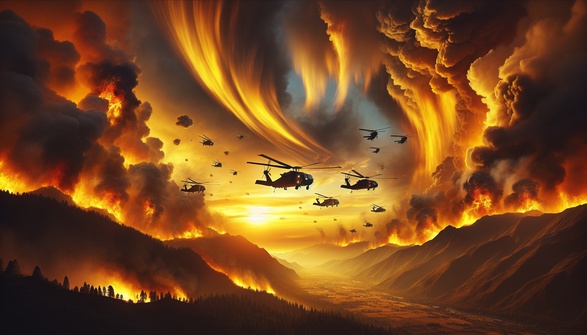
| tl;dr | Air tankers and helicopters are battling a wildfire near Phoenix, Arizona, which has led to evacuations as strong winds and high temperatures exacerbate the situation. Firefighters are working to control the flames and protect structures in the affected areas. | ||||
| deeper: | The article presents factual information about a wildfire near Phoenix, providing details about the firefighting efforts and the impact on local residents. It does not exhibit any apparent bias and maintains a neutral tone throughout. The quality of the reporting is high, with clear, concise, and relevant information. | ||||
media: | |||||
You made it to the bottom. Now dance!


owned and operated by: RPN Omnigalactic Insitutution as of: 2026/10/15: 11:46 in 0 ms
Enter Code
Login with Account